Your Wallet vs. The Economy: What Today's Big Government Reports Really Mean for Families

Pull up a chair. This morning the federal government released two of the most important economic reports of the year — the advance estimate for second-quarter GDP growth and the latest reading on the inflation gauge the Federal Reserve watches most closely. The numbers tell a story every family, every small business owner, and every household budget needs to hear right now.
The short version: the economy is still growing, but inflation is running more than twice as high as the target — and gas prices have jumped nearly 40% since February. Here's what you should know.
Here's What Happened
On July 30, 2026, the U.S. Bureau of Economic Analysis released two major economic reports simultaneously at 8:30 a.m. Eastern Time.
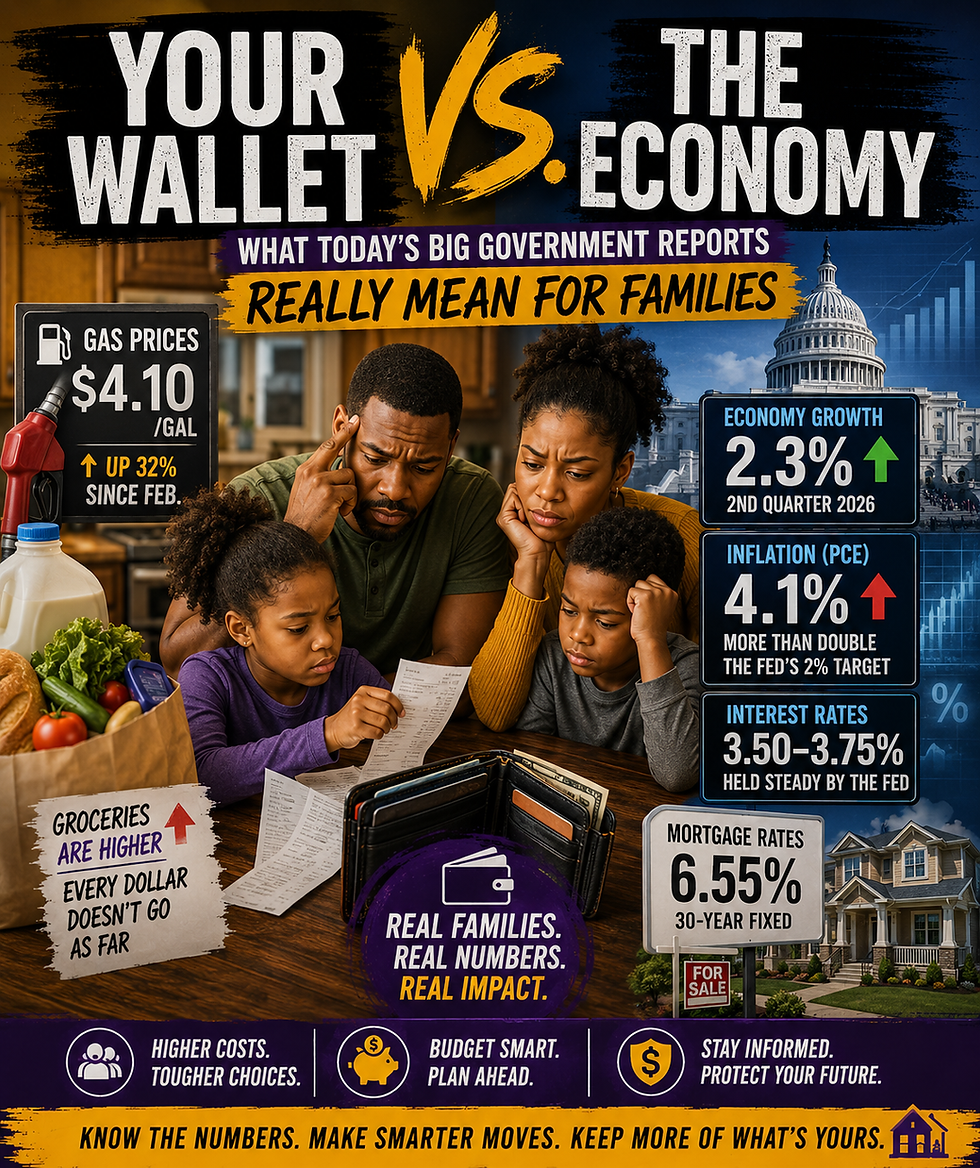
First, the advance estimate for second-quarter 2026 GDP growth. The economy grew at an annualized rate of approximately 2.3% in the second quarter, according to pre-release consensus from economists tracked by CalculatedRisk — a slight pickup from the confirmed 2.1% growth recorded in the first quarter of 2026. (Note: As of publication time, the official BEA figure was released this morning and we are citing the consensus forecast; readers can verify the official number at bea.gov.)
Second, the Personal Income and Outlays report for June 2026, which includes the Personal Consumption Expenditures (PCE) Price Index — the Federal Reserve's preferred inflation gauge. The most recent confirmed reading through May showed the PCE rising 4.1% over the prior year, according to the Bureau of Economic Analysis. That is more than double the Fed's 2% annual target.
At the same time, the national average price for regular gasoline has climbed to approximately $4.10 per gallon as of the week ending July 27, 2026, according to the U.S. Energy Information Administration. That is up roughly 32% from the $3.11 per gallon when the year began, pushed higher by escalating tensions in the Middle East.
Meanwhile, the Federal Reserve held its benchmark interest rate steady at 3.50–3.75% at its July 29 meeting — the fifth consecutive meeting without a change — as it monitors whether inflation will ease.
Why It Matters
Let's break this down. GDP growth tells us whether the overall economy is expanding or contracting. The fact that it continues to grow — even modestly — means businesses are generally still hiring and producing, and the economy has not slipped into recession.
But GDP growth alone does not tell you how families feel at the kitchen table. Inflation does.
When the PCE index runs at 4.1% — more than twice the Federal Reserve's 2% target — it means the purchasing power of every dollar in your pocket is being eroded faster than the Fed considers healthy. Groceries, energy, rent, insurance, car repairs: these everyday costs all inch upward when inflation persists.
And because the Federal Reserve fights inflation by keeping interest rates elevated, the ripple effect touches everything tied to borrowing — credit cards, car loans, home equity lines of credit, and mortgages. The 30-year fixed mortgage rate averaged 6.55% for the week of July 16, according to Freddie Mac. That is significantly higher than the rates many homeowners locked in during 2020 and 2021, creating what housing economists call the "lock-in effect" — millions of homeowners are reluctant to sell because doing so would mean trading a low rate for a much higher one.
There is one genuine bright spot: real wages — that is, wages adjusted for inflation — have been rising. Private-sector workers' average weekly earnings, adjusted for inflation, increased 1.3% during the current period, according to Bureau of Labor Statistics data. So while prices are rising, paychecks have been rising a little faster for many workers.
What This Means for the Village
For families: The squeeze is real. Gasoline at $4.10 a gallon means a family that spends $250 a month on fuel in February is now spending closer to $330 — an extra $80 per month, or nearly $1,000 per year, coming right out of grocery, savings, and childcare budgets.
For homebuyers and renters: Housing affordability remains deeply strained. The median existing-home price reached a record $440,600 in June 2026, according to the National Association of Realtors — up 1.8% year-over-year and marking 36 consecutive months of annual price increases. With mortgage rates hovering near 6.5–7%, monthly payments on a median-priced home are thousands of dollars more per year than they were three years ago.
For small business owners: Higher fuel costs hit delivery expenses, transportation, and supply chains. If you have business loans or lines of credit tied to variable rates, those costs remain elevated. The silver lining: consumer spending has held up enough to sustain GDP growth, meaning your customers still have money — they're just being more deliberate about where they spend it.
For retirees and those on fixed incomes: Inflation is particularly challenging when your income doesn't automatically rise with prices. Social Security's annual cost-of-living adjustment helps, but it often lags behind actual price increases in categories like healthcare, housing, and food.
For workers: If your wages have not kept pace with 4.1% inflation, you are effectively earning less in real purchasing power than you were a year ago, even if your paycheck looks the same or slightly bigger. This is the moment to have a conversation with your employer — or explore ways to grow additional income.
What You Can Do Now
Here are seven practical steps you can take today:
Audit your fuel spending. Use GasBuddy or the GasBuddy browser extension to find the cheapest gas near you. Combine errands into single trips. If you drive a lot for work, a fuel-efficient or hybrid vehicle could now pay for itself faster than ever.
Review your grocery strategy. Store brands and bulk purchases continue to offer 20–40% savings over name brands on many staples, according to consumer research. Discount grocery chains like Aldi and Lidl are worth adding to your rotation.
Put any extra cash in a high-yield savings account. Many online banks and credit unions are offering 4–5% annual percentage yields on savings accounts right now — meaning your savings are actually earning more than inflation-adjusted returns in a way that hasn't been possible in over a decade. Check Bankrate.com for current top rates.
Pay down high-interest credit card debt aggressively. With the Federal Reserve holding rates elevated, credit card interest rates average above 20% for many cards. Every dollar of high-interest debt you eliminate is a guaranteed 20%+ return on your money.
Ask for a raise or negotiate better terms. Because real wages have been rising for many workers, this is an active labor market where some employers are willing to negotiate. Document your value with specific contributions before the conversation.
If you're a homeowner, don't panic about rates — but do explore options. If you have significant equity, a Home Equity Line of Credit (HELOC) or cash-out refinance may be worth comparing against your current situation. Talk to at least two lenders and a HUD-approved housing counselor (housing.gov) before making any decisions.
For small business owners: update your pricing. If your costs have risen 10–15% over the past year, your prices likely need to reflect that to protect your margins. Review your cost of goods sold, fuel, shipping, and supply costs before your next pricing review.
How the Village Can Help
The village is strongest when it's prepared — and that means sharing knowledge.
Share this article with a neighbor, coworker, or family member who may not be watching economic news but will feel these numbers in their wallet.
If you know someone on a fixed income who is struggling with gas costs, offer to combine errands or share a Costco or Sam's Club membership for bulk grocery savings.
If your congregation, neighborhood association, or school hosts financial literacy events, this is a great moment to invite a local banker, credit union rep, or financial counselor to give a free talk on managing finances during high inflation.
Support local small businesses. Every dollar spent with a local business tends to circulate in the community up to three times more than dollars spent at national chains, according to the American Independent Business Alliance.
Sophie's Suggestions
When inflation is eating into your budget, getting organized and strategic makes a real difference. Here are a few items from Sophie's Mart that connect directly to the steps above:
Budget Planners & Financial Journals — A physical budget planner helps you track every dollar and identify exactly where inflation is hitting your household hardest. Seeing your spending patterns on paper is the first step to taking control of them.
Meal Planning Tools & Grocery Organizers — Meal planning is one of the most effective ways to reduce food costs during inflationary periods. A good meal planner or grocery list organizer can cut food waste and impulse purchases, which together account for significant household food budget losses.
Home Energy Efficiency Products — Small energy-saving investments — LED bulb sets, smart power strips, door draft stoppers, and programmable thermostats — reduce your utility bills month after month. When energy costs are elevated, these products pay for themselves faster.
Front Porch Takeaway
The economy may be growing, but growth at the national level doesn't always feel like growth at the kitchen table — and right now, the village's best tool against inflation is information, intentionality, and each other.
Sources
U.S. Bureau of Economic Analysis (BEA) — Personal Income and Outlays, Release Schedule: bea.gov
BEA — GDP (Third Estimate), 1st Quarter 2026, June 25, 2026: bea.gov
U.S. Energy Information Administration — Weekly Retail Gasoline Prices: eia.gov
Bureau of Labor Statistics — Consumer Price Index, July 14, 2026 (USDL-26-1191): bls.gov
Bureau of Labor Statistics — Real Average Weekly Earnings: bls.gov
National Association of Realtors — Existing Home Sales Report, June 2026: Nar. Realtor
Freddie Mac — Primary Mortgage Market Survey, July 16, 2026: freddiemac.com
FactCheck.org — Trump's Numbers, July 2026 Update (citing BEA, BLS, EIA, NAR, Federal Reserve primary sources): factcheck.org
McKissock — The Full Measure: July 2026 Economic Outlook (citing BEA, NAR, Census Bureau, Freddie Mac, Federal Reserve): mckissock.com
Federal Reserve Bank of Cleveland — Inflation Nowcasting, updated July 29, 2026: clevelandfed.org


Comments